



When designing a professional kitchen or reorganising workflow, understanding when a blast chiller is mandatory is essential for planning investments and ensuring compliance with food safety regulations.
The answer is straightforward: the law does not require every food service business to have a blast chiller. There is no general obligation to install one simply because you are opening a restaurant or a food production premises. However, certain food preparation processes require specific, measurable and documented temperature controls. In these cases, a blast chiller can be an essential tool for complying with the requirements of the HACCP plan and applicable food safety legislation. For example:
- If you serve raw or lightly cooked fish, an appropriate freezing treatment to eliminate parasites must be carried out, unless an exemption applies. The requirement concerns parasite control, subject to the applicable exemptions, as well as safe chilling.
- If your workflow involves cooking followed by chilled storage, food must be cooled as quickly as possible to a temperature that does not pose a risk to health, in accordance with Regulation (EC) No 852/2004 and your own HACCP plan.
In this guide, we take a closer look at what the health and hygiene regulations stipulate,
in which situations a blast chiller is a legal requirement and when, on the other hand, it is the best choice for organising production and maintaining high dish quality.
Blast chillers and food safety regulations: what the law says
To clarify the relationship between blast chillers and food safety regulations, the key European reference is Regulation (EC) No 852/2004 on food hygiene .
Article 5 of this regulation requires every food business operator to establish and implement food safety procedures based on the HACCP principles. In particular, Annex II, Chapter IX, point 6, sets out a fundamental rule for temperature control in food handling:
“Where food products are to be kept or served at chilled temperatures, they must be cooled as quickly as possible following the heat-treatment stage […] to a temperature that does not pose a risk to health.”
Food safety regulations governing blast chillers establish hygiene requirements and temperature control measures that food businesses must comply with. The operator, working alongside their food safety consultant, is responsible for identifying Critical Control Points (CCPs) and defining how they should be managed. If a process requires cooked food to be cooled within a specified time, a blast chiller may become the necessary practical tool for achieving this outcome and demonstrating compliance through objective, measurable data.
During inspections by the local health authority (ASL) or the NAS food safety unit, inspectors check that the procedures described in the HACCP plan are consistent with actual practices. Failure to implement food safety procedures or to adopt adequate measures to prevent risks can result in financial penalties, as well as official requirements for corrective action or, in more serious cases, the suspension of business operations.
When is a blast chiller mandatory: the circumstances in which it is required
Let’s look at the practical details. Certain food preparation processes require carefully controlled treatments, for which a blast chiller provides a dedicated professional solution.
Raw or lightly cooked fish and the associated risks
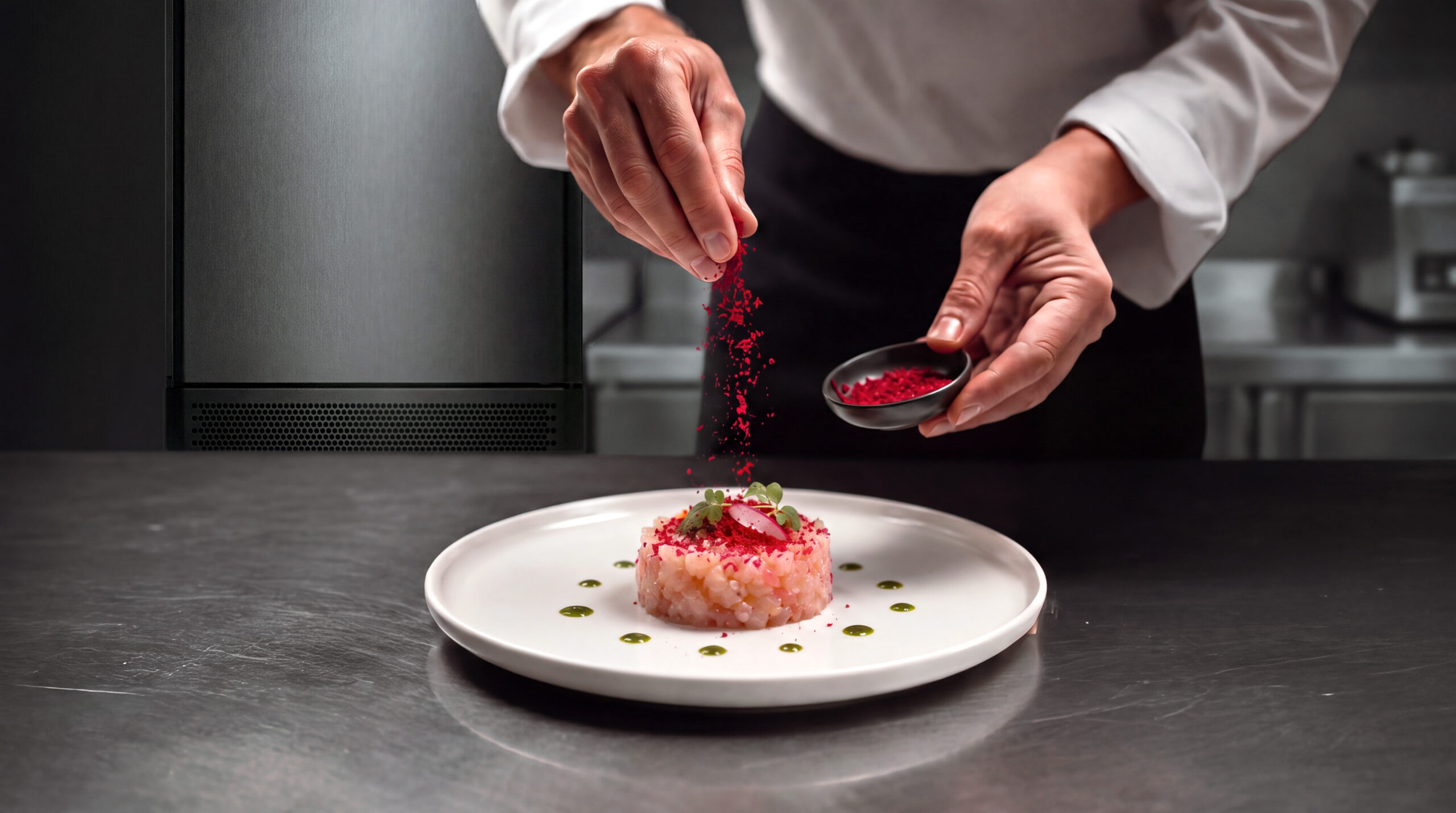
When serving tartare, carpaccio, sushi, sashimi or marinades made with raw fish (such as anchovies), you must adhere to very specific safety guidelines.
The relevant legislation is Regulation (EC) No 853/2004 (Annex III, Section VIII, Chapter III), as amended by Regulation (EU) No 1276/2011. For the fish products concerned, the legislation requires a preventive freezing treatment to eliminate parasites, unless an expressly permitted and documented exemption applies:
- At a temperature of –20°C or below for at least 24 hours throughout the product; or
- At a temperature of -35°C or below for at least 15 hours at the core of the product.
This treatment is essential for killing any live parasites that may be present in the fish.
A standard domestic freezer or storage freezer is not designed for this purpose: it is intended to keep food that is already frozen, rather than rapidly freezing fresh products. It can take many hours to reach -20°C at the core of the product, encouraging the formation of large ice crystals that damage the fish’s muscle fibres, resulting in a loss of texture and juices when defrosted.
A professional blast chiller equipped with a probe, such as the Evolution 10-Tray model, allows the internal temperature of the product to be monitored. In models with data-recording capabilities, this function can also help document food safety procedures and support HACCP compliance.
Cooked foods for chilled storage and bacterial growth
When you cook food but do not serve it immediately, intending instead to store it under refrigeration (between 0°C and +4°C), you must manage the temperature danger zone between +65°C and +10°C. This is the range in which bacteria such as Bacillus cereus and Clostridium perfringens can multiply rapidly.
Good hygiene practice guidelines recommend cooling food from +70°C to +3°C at the core within a maximum of 90 minutes. Placing large quantities of hot food in a refrigerator that is not designed to handle such a load can slow down the cooling process and raise the temperature of other stored products.
Advance food preparation and chilled storage (cook & chill)
In kitchens that use the cook & chill method, commonly found in large restaurants, catering businesses and central production kitchens, food is cooked, rapidly chilled to +3°C and regenerated (reheated) just before serving. In this type of operation, the blast chiller is at the heart of the system. It allows production to be planned in advance while helping to control microbiological risks and preserve the products’ sensory qualities.
Practical examples of when a blast chiller is required
Let’s look at how these requirements apply across different professional food service sectors.
Blast chiller requirements for restaurants
For restaurants that carry out parasite-killing freezing treatments on fish in-house, a suitable blast chiller allows this process to be managed under controlled conditions. If the treatment has already been carried out by the supplier, the relevant documentation must be obtained. Any exemptions provided for under the applicable legislation remain valid.
However, the benefits go beyond formal compliance. In the day-to-day running of a high-quality professional kitchen, preparing stocks, sauces, portions of meat or pasta dish bases and blast chilling them to +3°C helps maintain consistent quality, speed up service and minimise waste of costly ingredients.
Blast chiller requirements for delicatessens
In delicatessen kitchens, production often takes place in large batches. Baked dishes, roasts, oven-baked pasta dishes and sauces are prepared in deep trays and intended for display in refrigerated counters.
In this sector, the blast chiller is a key piece of delicatessen equipment. Rapid cooling helps limit residual cooking and ensures a controlled transition to chilled storage. It also supports a more controlled approach to determining shelf life, which must be assessed according to the specific product and preparation process.
Blast chiller requirements for patisseries
Patisseries regularly work with delicate ingredients such as fresh eggs, milk, cream and mascarpone. Choosing the right patisserie equipment has a direct impact on both food safety and technical precision.
A blast chiller makes it possible to lower the temperature in a short time (depending on the load), helping to reduce the risk of bacterial growth. In addition, rapid freezing to -18°C helps stabilise individual portions, inserts and semifreddos. The formation of smaller ice crystals helps preserve the structure of these preparations and makes subsequent glazing operations easier.
Beyond compliance: the benefits of a blast chiller in the kitchen
Viewing a blast chiller solely as a cost imposed by food hygiene regulations means overlooking much of its value. When fully integrated into daily workflows, it becomes a tool for improving profitability:
- Preserved sensory quality: Rapid cooling helps protect the food’s cellular structure. When defrosted, products lose less moisture, helping to preserve their weight, texture and flavour.
- Less waste and smarter purchasing: Using a blast chiller alongside proper refrigerated storage (in professional refrigeration cabinets) helps you plan production more effectively and reduce waste and surplus stock.
- Better staff scheduling: Complex, time-consuming preparations can be concentrated on quieter days or during off-peak hours, easing pressure on the team during busy service periods.
- Simplified traceability: Models equipped with the relevant features can record and export cycle data, helping to support food safety monitoring and HACCP documentation procedures.
Ilsa blast chillers
For over 40 years, we at Ilsa S.p.A. have been designing and manufacturing professional refrigeration equipment at our facility in San Fior (Treviso). Our Made in Italy products are built around one clear principle: making everyday work easier for chefs and food service professionals.
Our range caters to the needs of both small workshops and large-scale production facilities:
- Models for 4 to 160 trays: Solutions compatible with GN 1/1 and 60 × 40 cm Euronorm standards, available in compact, mobile and roll-in versions for trolley loading.
- Precisely calibrated positive and negative cycles: Chilling cycles to +3°C and rapid freezing to -18°C at the core of the product, with Soft and Hard modes available on selected models.
- Precision control: Multipoint food probes and thermal cycle storage for consistent HACCP monitoring and documentation.
- Dedicated functions: Depending on the model, features include programmes for parasite-killing treatment of fish, pre-cooling the chamber and automatic transition to storage mode at the end of the cycle.
Discover Ilsa’s range of professional blast chillers and find the model best suited to your business’s production volumes.


